Mirissa and Trincomalee are Sri Lanka’s best-known bases for whale-watching trips, but neither coast offers guaranteed sightings or perfectly calm water. Your best option usually depends on the season: the south is generally more suitable during the drier months from December to April, while the northeast typically has its better window from around May to September.
Blue whales are the headline attraction, alongside possible sightings of sperm whales, Bryde’s whales and dolphins. However, these are wide-ranging wild animals, and their presence changes with ocean conditions, food availability and other natural factors. A responsible operator should set realistic expectations rather than promise a particular species.
This guide compares the two coasts for first-time visitors, with practical advice on timing, boat comfort, ethical standards and what to expect on the day.
Whale-Watching Seasons in Sri Lanka
Sri Lanka’s monsoon patterns strongly influence wind, rain and sea conditions. This is why whale watching is usually promoted on different coasts at different times of year. The seasons are useful planning guides, not fixed guarantees: monsoon timing can shift, and rough water or poor visibility can occur even in a normally favourable month.
Typical Mirissa season
Mirissa’s main whale-watching period generally runs from December to April, with some operators starting in November if conditions allow. The south coast is usually drier during this period, although offshore swells, wind and rain are still possible. Departures become less dependable as the southwest monsoon develops, commonly around May.
Typical Trincomalee season
Trincomalee’s season is commonly described as May to September, with June to August often offering the most settled conditions. This broadly coincides with rougher weather on the southwest coast. The northeast can nevertheless receive rain, wind and changing sea conditions, particularly near the edges of the season.
May, October and November are transitional months. Tours may operate, but it is sensible to keep plans flexible and confirm locally. If whale watching is a priority, avoid arranging it immediately before a flight or a long transfer because weather-related postponements and cancellations are possible.
Mirissa: More Choice and More Boat Traffic
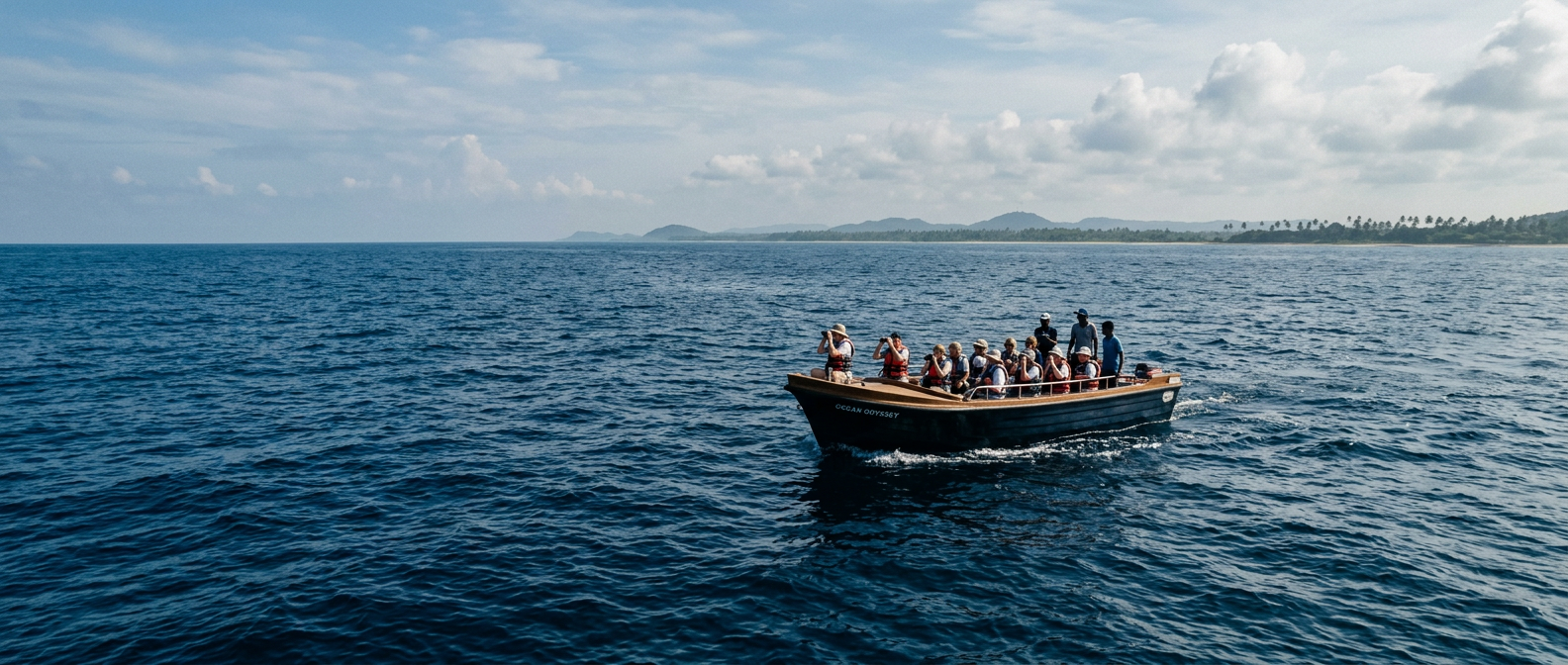
Mirissa is Sri Lanka’s most established whale-watching centre. Boats usually leave early from Mirissa Fisheries Harbour and travel offshore, often in the direction of the deeper waters beyond the south coast. Depending on conditions and where animals are encountered, a trip may last roughly three to five hours or longer.
The large number of operators gives travellers a choice of boat sizes and service levels. Larger vessels may have covered seating, toilets and more space to move, while smaller boats can carry fewer passengers but feel the swell more strongly. Facilities vary considerably, so ask for current details rather than relying only on photographs or an agent’s description.
Mirissa’s principal disadvantage is congestion. During busy periods, several boats may respond to the same sighting. This can reduce the quality of the experience and place pressure on animals if captains approach too quickly or crowd their route. Selecting an operator that prioritises distance and patient observation matters more than choosing the boat advertising the closest encounter.
Mirissa suits travellers visiting the south between December and April, particularly those who value a broad choice of operators, accommodation and larger boats. It can also be combined easily with Weligama, Galle, Unawatuna or other south-coast stops.
Trincomalee: A Seasonal East-Coast Option
Trincomalee is the main alternative during the east coast’s calmer period. Trips may depart from locations around Trincomalee, Uppuveli or Nilaveli, depending on the operator and local permissions. Confirm the exact meeting point, transport arrangements and launch method before paying, as these details can differ.
Deep offshore waters and submarine features in the wider Trincomalee area support a range of marine life. Blue whales, sperm whales and dolphins may be encountered, but sightings vary and should never be treated as certain. Some trips also focus on dolphins, so check whether an operator is offering a dedicated whale-watching excursion or a more general marine safari.
The east-coast industry is smaller than Mirissa’s and the atmosphere may feel less commercial. That does not automatically mean every trip is quiet or responsibly managed. Boat size, crew experience and wildlife practices still need careful checking. Smaller craft are common and can be uncomfortable for travellers with limited mobility, back problems or a strong sensitivity to motion.
Trincomalee is generally the more logical choice for visitors travelling from May to September or already exploring the Cultural Triangle and east coast. It should not be presented as the only possible summer option, but it is usually the most established base during that period.
Mirissa or Trincomalee: Which Should You Choose?
- Choose Mirissa from December to April if it fits your route and you prefer a larger selection of boats, hotels and established tourism services.
- Choose Trincomalee from May to September if you are travelling on the east coast and want the seasonally more suitable departure area.
- Choose a larger vessel if stability, shade, toilets or easier movement are priorities, while remembering that no ocean-going boat is completely steady.
- Choose a smaller group carefully if you value a quieter experience, but ask about seating, shade, safety equipment and the physical demands of boarding.
- Skip or reschedule the trip if the sea forecast is poor, the operator seems evasive about safety or wildlife practices, or you are uncomfortable with the boat offered.
Sea Conditions and Motion Sickness
Both destinations involve open-ocean travel rather than a sheltered cruise. Even on a bright day, long rolling swells can cause motion sickness. Smaller boats generally move more noticeably, although vessel design, speed, wind direction and where you sit also affect comfort.
If you are concerned about motion sickness, ask a doctor or pharmacist which precautions are appropriate for you and follow the product instructions. Some medicines can cause drowsiness or may not be suitable with particular health conditions or other medication. Do not wait until boarding to seek individual medical guidance.
Practical measures may help: eat a light meal, avoid excessive alcohol the previous evening, stay hydrated, face forward and look toward the horizon rather than continuously through a camera. Bring sun protection and keep essential items in a waterproof pouch. If you become unwell, tell the crew and remain seated where they advise.
Families should ask about minimum ages, child-sized life jackets, railings, toilet access and whether the crew can return early. Travellers who are pregnant or who have mobility, balance, spinal or significant health concerns should obtain appropriate professional advice and discuss boarding conditions directly with the operator.
How to Choose an Ethical Whale-Watching Operator
Whale-watching quality varies, and responsible behaviour cannot be judged from price alone. Sri Lankan authorities regulate marine wildlife tourism, but visitors should still assess how an operator behaves in practice. Membership logos and sustainability language can be useful starting points, not proof of good conduct.
Ask specific questions before booking:
- How does the crew approach whales? Look for a commitment to slow, predictable movement, respectful separation and avoiding an animal’s direct path.
- What happens when several boats find the same animal? A responsible captain should be prepared to wait, keep clear or leave rather than join a tight cluster.
- How long does the boat remain at a sighting? Prolonged pursuit can disturb animals, particularly mothers with calves or whales repeatedly changing direction.
- Are sightings guaranteed? Ethical operators explain that wildlife cannot be guaranteed. Ask what their policy is if no whales are seen, but do not treat a free repeat trip as a promise of success.
- Is there a trained naturalist or knowledgeable guide? Good interpretation can make distant sightings more rewarding and helps passengers understand why space must be maintained.
- What safety equipment is carried? Confirm that suitable life jackets are available for every passenger and ask about communication equipment, passenger limits and bad-weather procedures.
Responsible observation means allowing whales to control the encounter. Boats should not race directly toward animals, box them in, separate members of a group or repeatedly cut across their direction of travel. Engine use depends on the situation and safe vessel handling, so simplistic promises to switch engines off near every whale are not necessarily a reliable quality test.
If conduct on the water concerns you, raise it calmly with the guide or operator when safe to do so. Record the boat name, date and time if you intend to make a factual complaint to the relevant local authority or booking platform.
Booking and Departure-Day Tips
- Book for an early day in your stay. This leaves room to reschedule if the sea is unsuitable.
- Confirm what the price includes. Ask about harbour transfers, food, water, taxes, life jackets and cancellation or no-sighting policies.
- Check the latest forecast and operator message. Conditions offshore may differ from those on the beach.
- Arrive on time. Departures are usually early, and harbour access or beach launching can take longer than expected.
- Pack lightly. Bring a hat with a secure strap, reef-conscious sun protection, water, sunglasses and a waterproof bag. Avoid single-use plastics where possible.
- Use a camera strap. A moderate zoom is usually more useful than trying to photograph an animal at very close range.
Set Realistic Expectations
A whale-watching trip is not a staged attraction. You may see a blue whale’s blow and back at a distance without seeing its tail, encounter dolphins instead, or return without a cetacean sighting. Trips can also involve long periods of searching in sun, wind and swell.
For most first-time visitors, the calendar provides the clearest answer: Mirissa is generally better placed from December to April, while Trincomalee is usually the seasonal choice from May to September. Beyond that, compare boats, safety procedures and wildlife practices rather than choosing only by price.
With flexible plans and a responsible operator, either coast can offer a memorable view of Sri Lanka’s marine environment. The best encounter is not necessarily the closest one, but one that is safe for passengers and leaves the animals free to travel undisturbed.